TalentMatch User Guide
🚀 Revolutionize Your Recruitment Process
TalentMatch is the ultimate power tool for HR recruiters in Singapore SMEs who are drowning in internship applications from local universities and need a lifeline. Say goodbye to spreadsheet nightmares and scattered emails!
💪 Built for Busy HR Professionals Like You
Are you tired of:
- Losing track of promising candidates?
- Forgetting which round of interviews applicants are in?
- Struggling to match the right skills to the right positions?
- Wasting hours on administrative busywork instead of finding your next star intern?
TalentMatch combines lightning-fast command-line efficiency with intuitive visuals to give you complete control over your recruitment pipeline. Our SME-focused solution lets you manage your entire internship program from a single dashboard.
⚡ Work at the Speed of Thought
With TalentMatch's CLI interface, you can:
- Process applications 3x faster than traditional methods
- Track candidate progress across multiple interview rounds
- Visualize your talent pipeline with powerful stats and charts
- Never lose an applicant's details again with automatic data organization
The more you type, the more time you save. Master our simple commands and watch your productivity soar!
Quick start
Ensure you have Java
17or above installed in your Computer.
Mac users: Ensure you have the precise JDK version prescribed here.Download the latest
.jarfile from here.Copy the file to the folder you want to use as the home folder for your AddressBook.
Open a command terminal,
cdinto the folder you put the jar file in, and use thejava -jar TalentMatch.jarcommand to run the application.
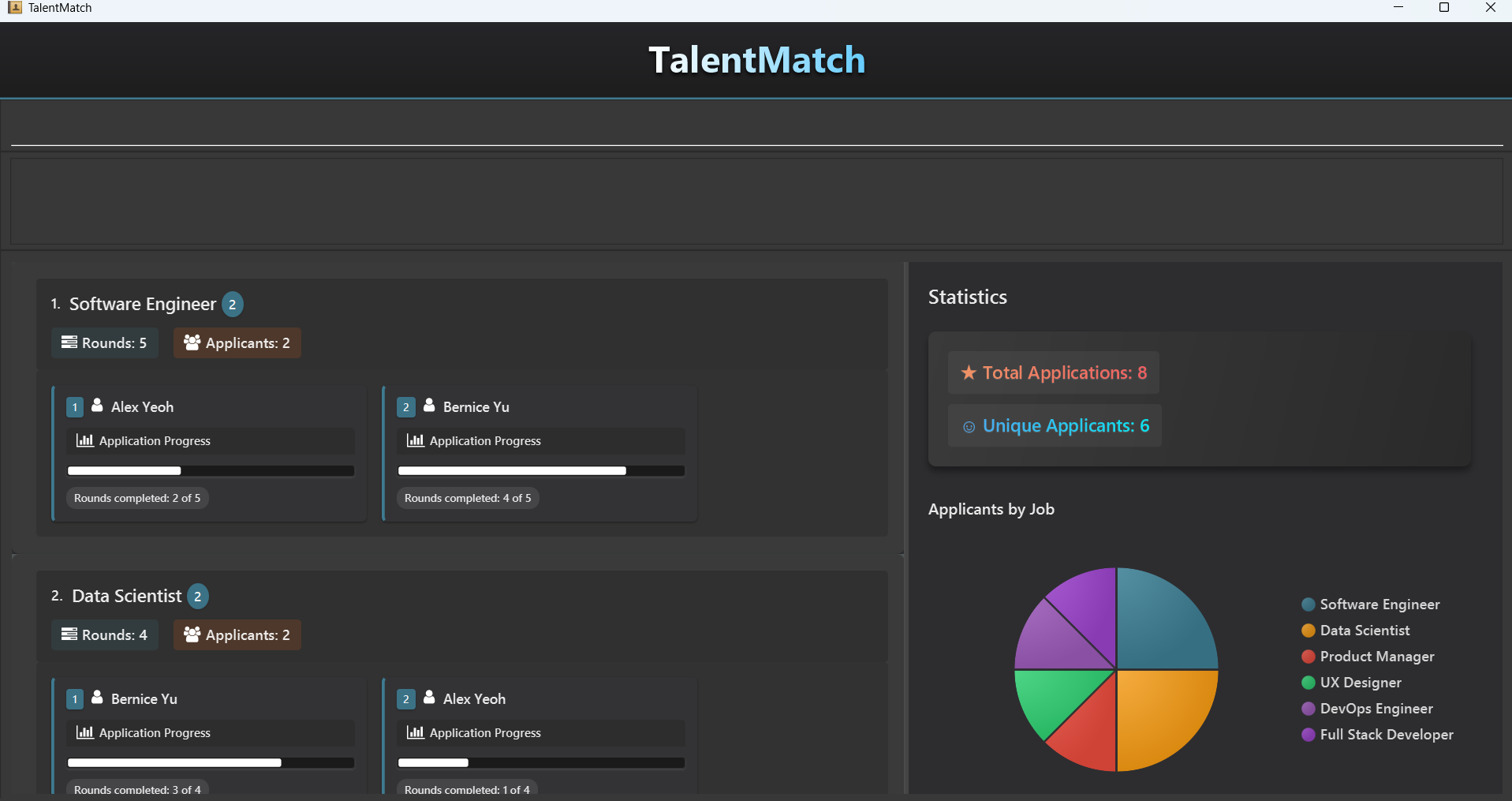
A GUI similar to the below should appear in a few seconds. Note how the app contains some sample data.
Type the command in the command box and press Enter to execute it. e.g. typing
helpand pressing Enter will open the help window.
Some example commands you can try:
listjob: Lists all job entries.addjob jt/Software Developer jr/3 k/JavaScript: Adds a job titledSoftware Developerto TalentMatch.deljob 3: Deletes the 3rd job shown in the current list.clear: Deletes all entries.exit: Exits the app.
Refer to the Features below for details of each command.
Features
Command History
TalentMatch supports remembering command history, allowing you to be able to navigate through your past inputs and reduce the need to type out every command from scratch!
Simply use the up and down arrow keys after clicking on the command box text input area and navigate through your past inputs like how you would in terminal.
Notes about the command format:
Words in
UPPER_CASEare the parameters to be supplied by you.
e.g. inadd n/NAME,NAMEis a parameter which can be used asadd n/John Doe.Items in square brackets are optional.
e.gn/NAME [k/SKILL]can be used asn/John Doe k/Pythonor asn/John Doe.Items with
… after them can be used multiple times including zero times.
e.g.[k/SKILL]…can be used as(i.e. 0 times),k/Python,k/Java k/Pythonetc.Parameters can be in any order.
e.g. if the command specifiesn/NAME p/PHONE_NUMBER,p/PHONE_NUMBER n/NAMEis also acceptable.All prefixes and commands used in TalentMatch are case-sensitive.
e.g. if the command specifiesn/NAME p/PHONE_NUMBER,N/NAME P/PHONE_NUMBERis not acceptable.
e.g. if the command specifiesaddjob jt/JOB_TITLE,ADDJOB JT/JOB_TITLEis not acceptable.All parameters that accept alphanumeric characters are case-insensitive, except for
EMAIL.Extraneous parameters for commands that do not take in parameters (such as
help,list,exitandclear) will be ignored.
e.g. if the command specifieshelp 123, it will be interpreted ashelp.Job commands should be called only in job view while person commands should be called only in person view. This is to ensure you can see real time updates in response to their queries.
If you are using a PDF version of this document, be careful when copying and pasting commands that span multiple lines as space characters surrounding line-breaks may be omitted when copied over to the application.
Generic commands
Commands that are suitable for use in either person view or job view.
Viewing help : help
Shows a message explaining how to access the help page.

Format: help
Switching views : switch
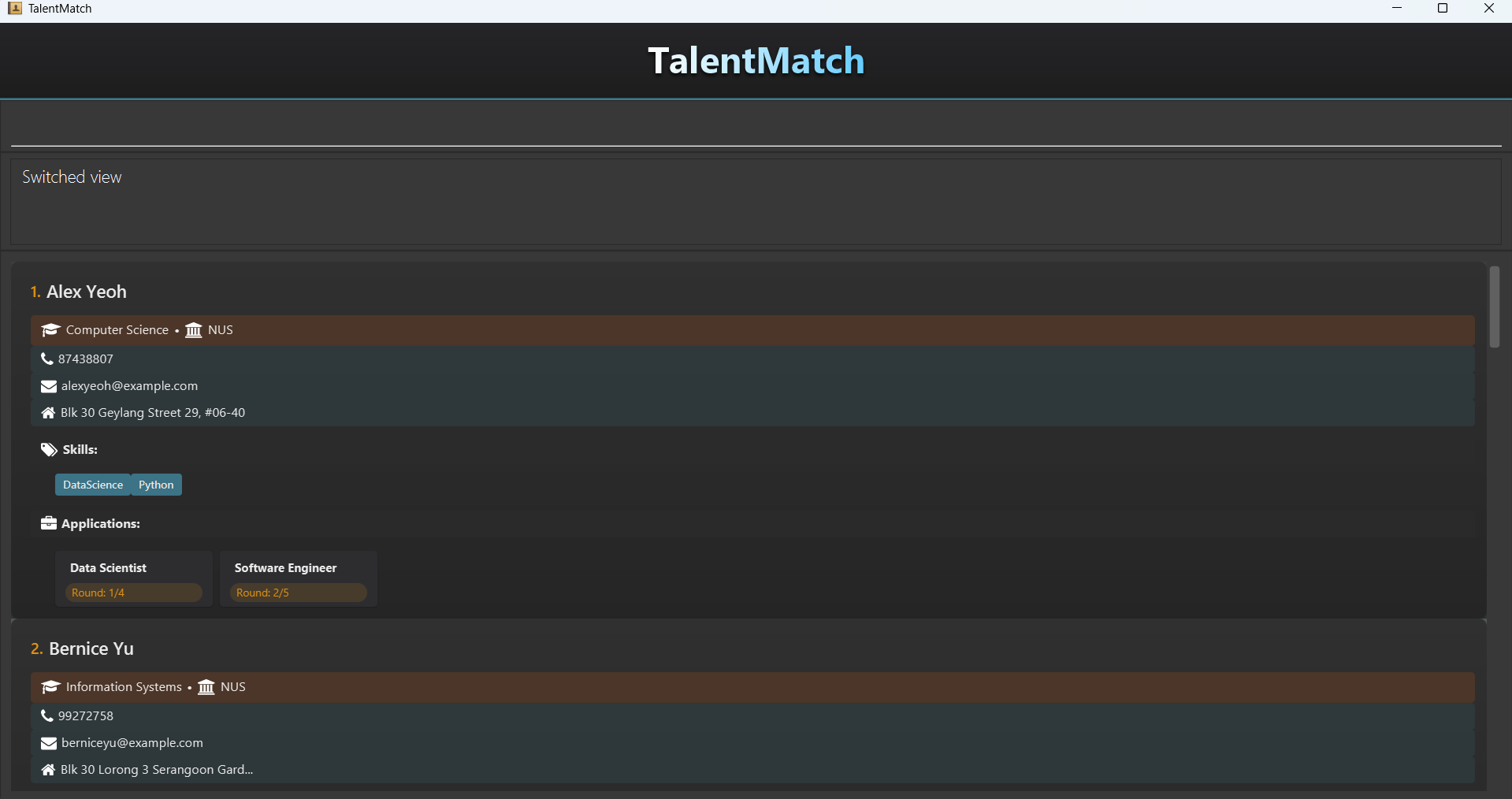
Switches the view of GUI from job view to person view and vice versa.
Please note the differences in job view and person view as the commands available are different.
Job View: Displays a list of all jobs and applications
Person View: Displays a list of all persons
Format: switch
Clearing all entries : clear
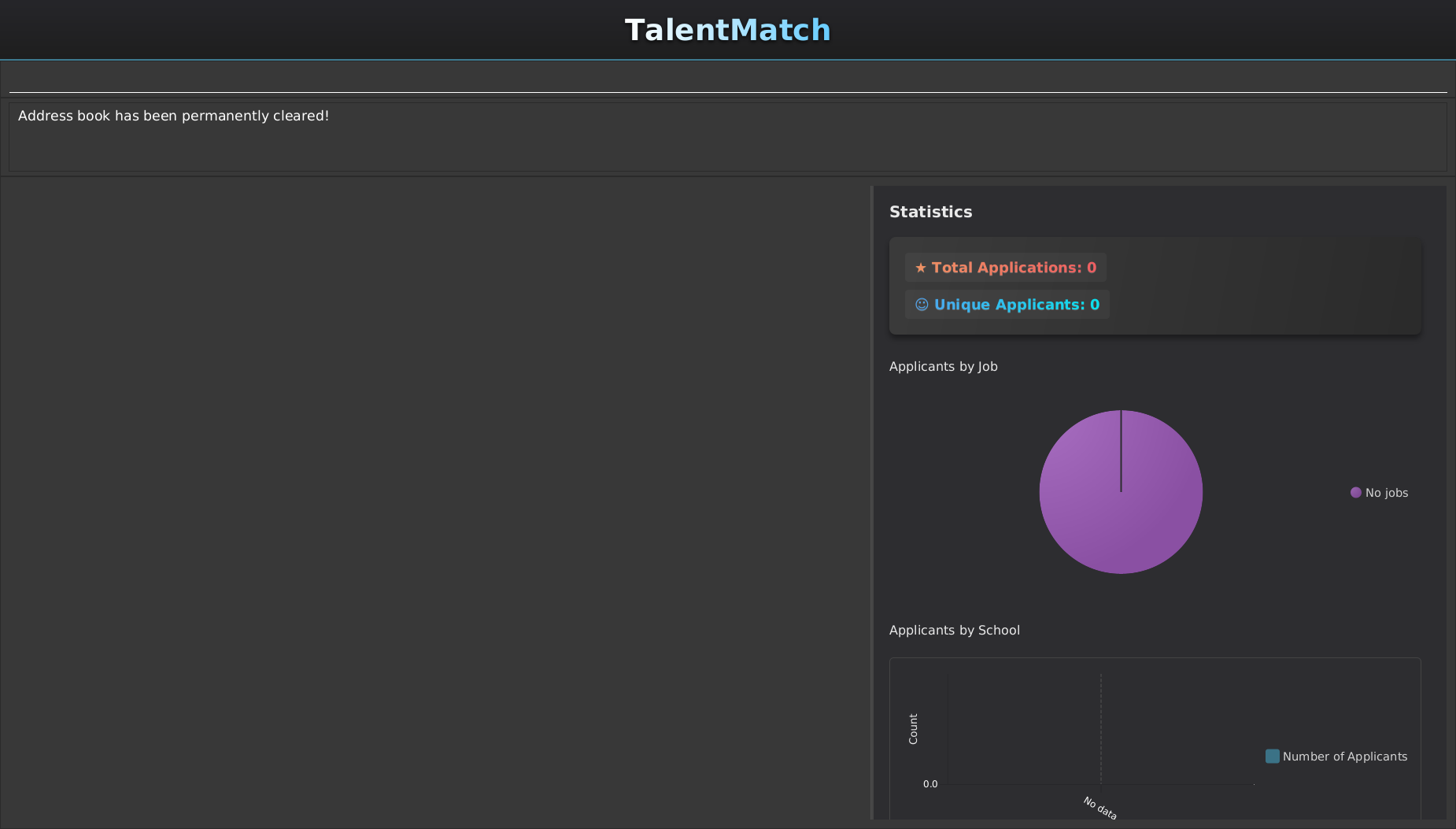
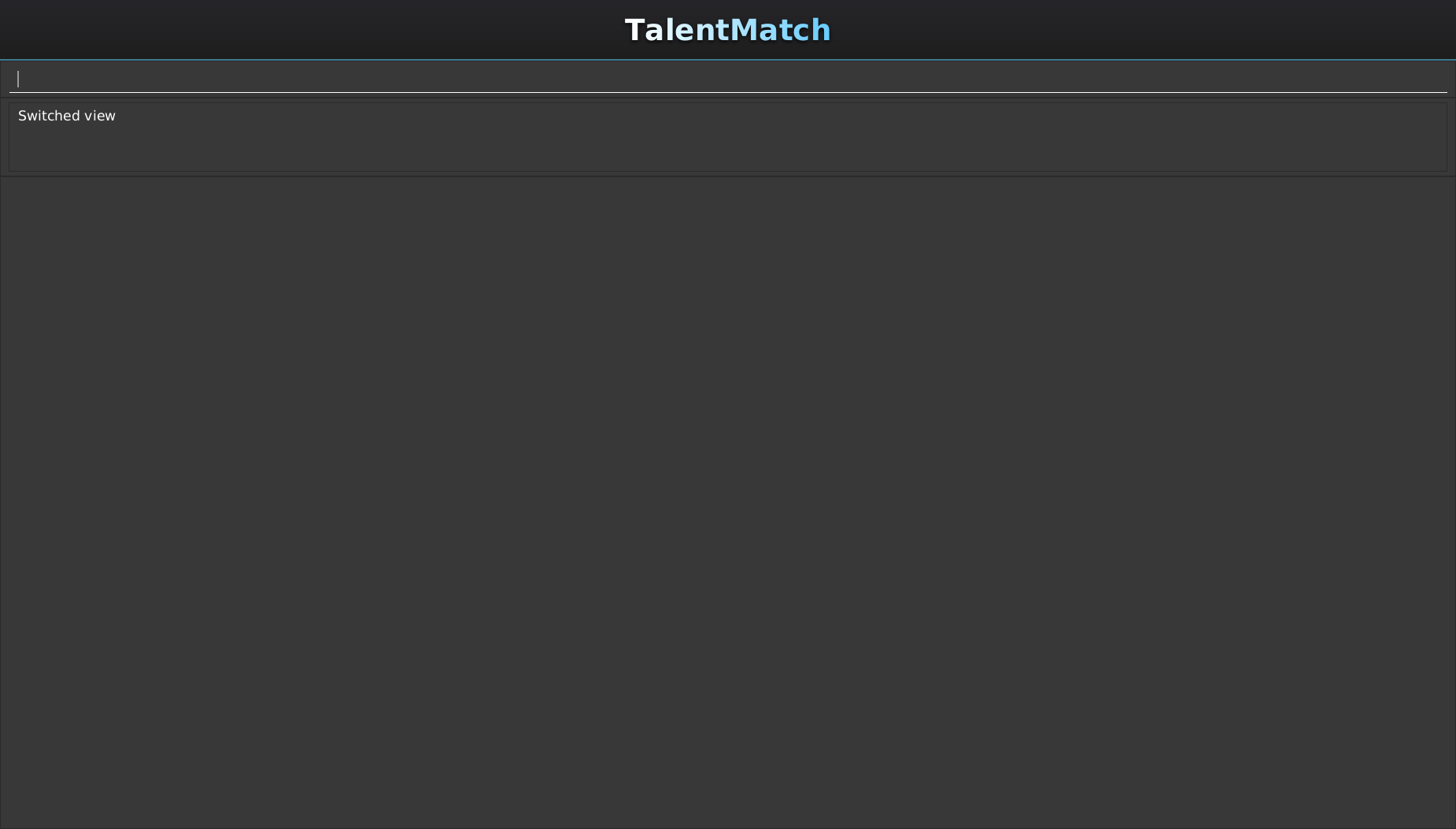
Clears all entries from TalentMatch, removing applications, jobs and persons.
Format: clear
Expected Output:
Exiting the program : exit
Exits the program.
Format: exit
Job Commands
These commands support CRUD operations on Jobs and are only available to you in Job View so that you are able to see real time updates on the GUI.
| Parameters | Definition | Constraints |
|---|---|---|
JOB_TITLE | Name of the job opening | Only alphanumeric characters and spaces allowed, and should not be blank. |
JOB_ROUNDS | Number of rounds that an applicant has to complete before receiving an offer | Must be a positive integer between 1 and 10 (inclusive). |
SKILL | Skills that are required by the job | Only alphanummeric charcters are allowed, with the exception of . and /. Skills should only be one word with no spaces. |
INDEX | Index of the job in the displayed job list in Job View | Must be a natural number and should be an index displayed in Job View. |
Adding a job: addjob
Adds a job to TalentMatch
Format: addjob jt/JOB_TITLE jr/INTERVIEW_ROUNDS [k/SKILL]…
Tip: A job can have any number of skills (including 0)
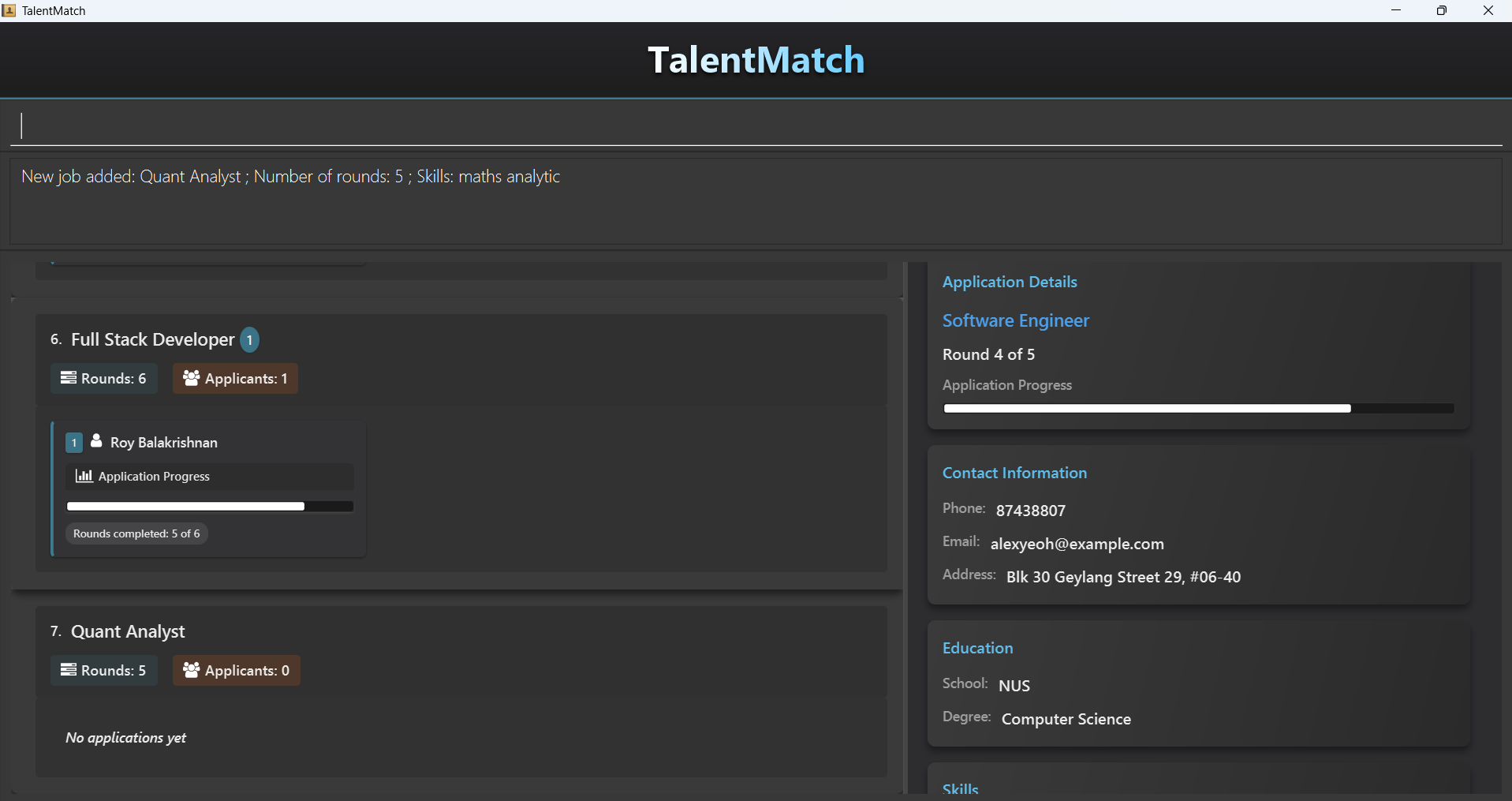
Expected output:
addjob jt/Quant Analyst jr/5 k/Maths k/Analytic adds a job with the specified details
Examples:
addjob jt/Software Engineering jr/3 k/React k/JavaScriptadds Software Engineering job with 3 rounds and requires applicants to know React and JavaScript.
Editing a job: editjob
Edits an existing job in TalentMatch.
Format: editjob INDEX [jt/JOB_TITLE] [jr/JOB_ROUNDS] [k/SKILL]…
- Edits the job at the specified
INDEX. The index refers to the index number shown in the displayed job list. - The index must be a natural number 1, 2, 3, …
- At least one of the optional fields must be provided.
- Existing values will be updated to the input values.
- When editing job skills, the existing skills of the person will be removed i.e adding of skills is not cumulative.
- You can remove all the job's skills by typing
k/without specifying any skills after it.
Warning:
Attempting to change JOB_ROUNDS to a number less than the application status of any current applicant for that job will result in an error.
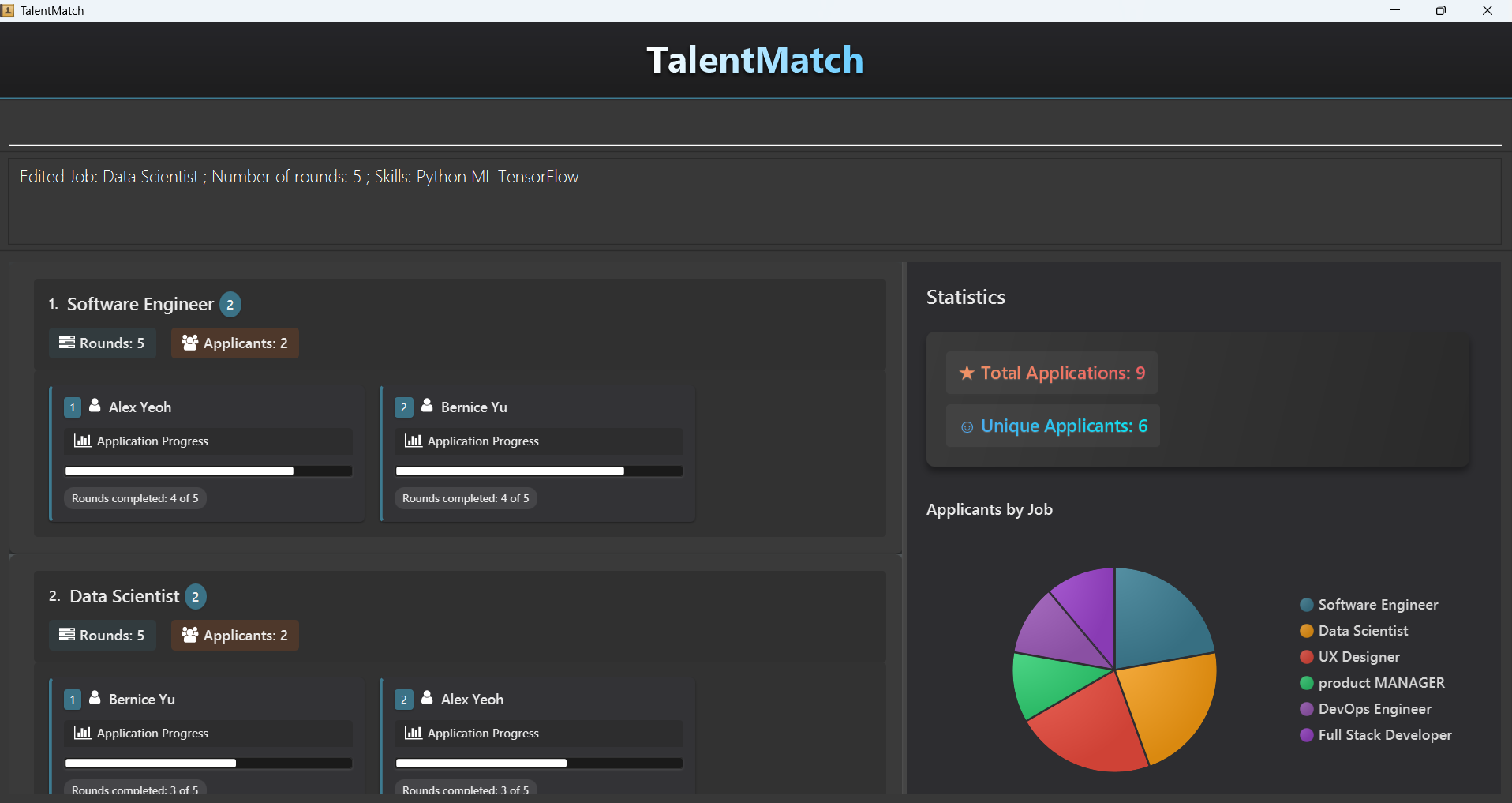
Expected output:
editjob 2 jr/5 edits the 2nd job and changes JOB_ROUNDS to 5.
Examples:
editjob 7 jt/Software Engineering jr/3edits the 7th job and changes itsJOB_TITLEto Software Engineering andJOB_ROUNDSto 3.
Listing all jobs: listjob
Shows a list of all jobs in TalentMatch.
Format: listjob
Locating jobs: findjob
Finds jobs whose details contain any of the given keywords.
Format: findjob KEYWORD [MORE_KEYWORDS]…
- The search is case-insensitive. e.g.
softwarewill matchSoftware - The order of the keywords does not matter. e.g.
Engineering Softwarewill matchSoftware Engineering - Only full words will be matched e.g.
Engiwill not matchEngineer - Jobs matching at least one keyword will be returned (i.e.
ORsearch).
e.g.Engineerwill returnSoftware Engineer,AI Engineer - Keywords are searched across multiple fields.
e.g.
findjob 2will return jobs that contain 2 any of the searchable fields. - Keywords used in a single
findjobcommand searches the displayed list using logical OR. e.g.findjob data engineeringwill returnSoftware EngineeringandData Scientist - Consecutive
findjobcommands continue the search based on the current displayed list. e.g.findjob data engineeringfollowed byfindjob engineeringwill only returnSoftware Engineering - To reset the displayed list (i.e. when the displayed list is empty or the job you are searching for is no longer in the list), use
listjobto reset back to original list and continue searching again.
Searchable fields:
- JOB_TITLE
- JOB_ROUNDS
- SKILL
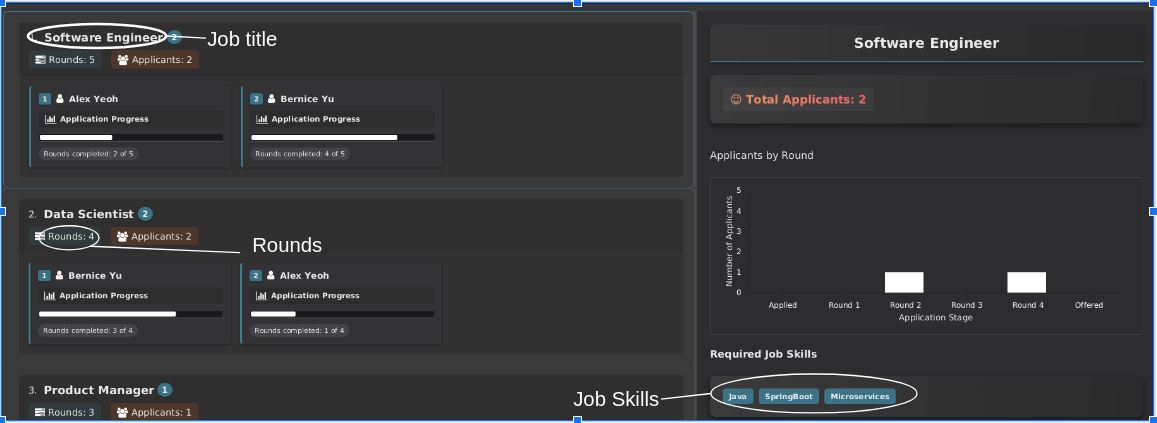
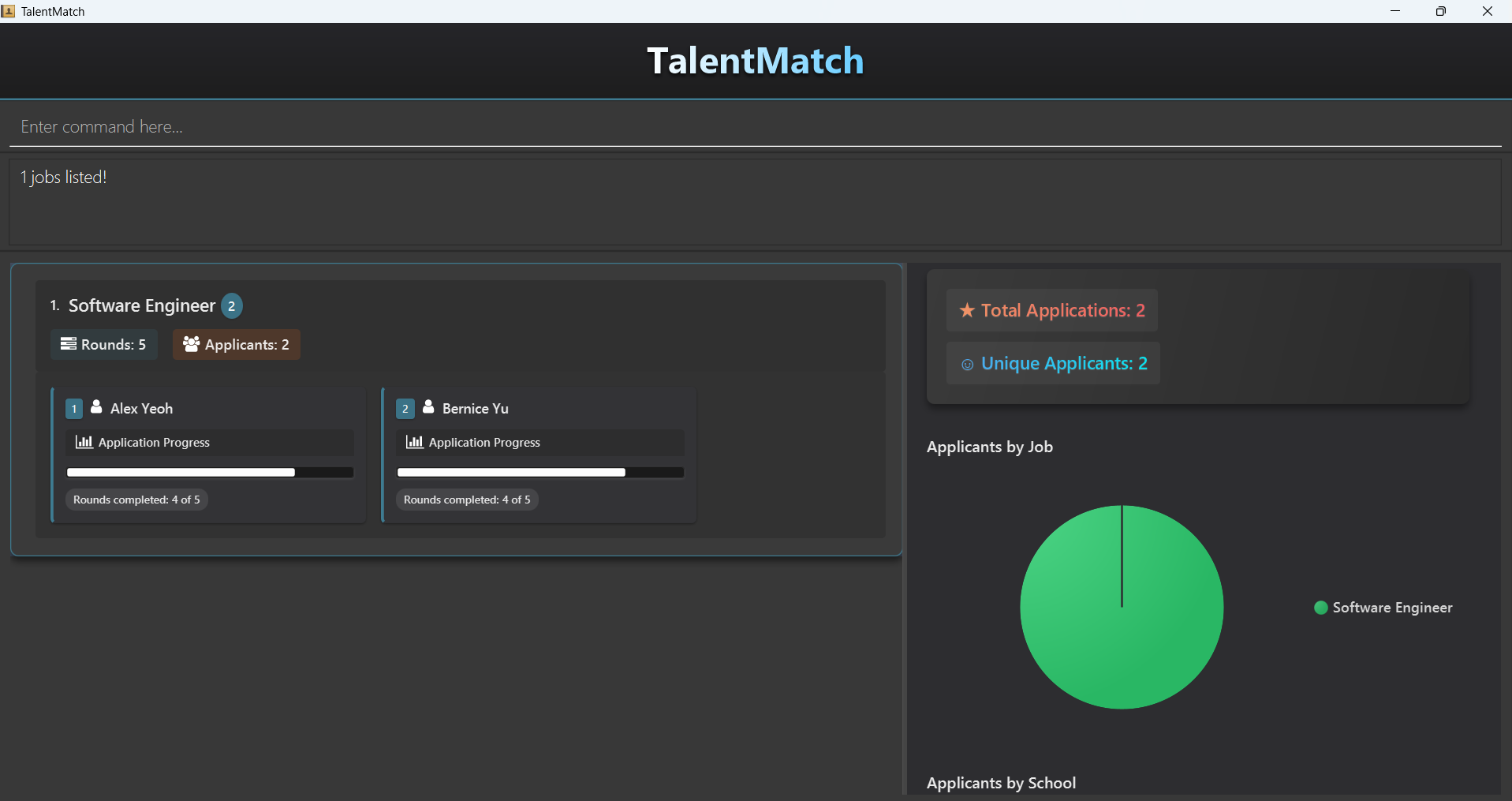
Expected output:
findjob data engineerreturns jobs which contain data or engineer in their details.
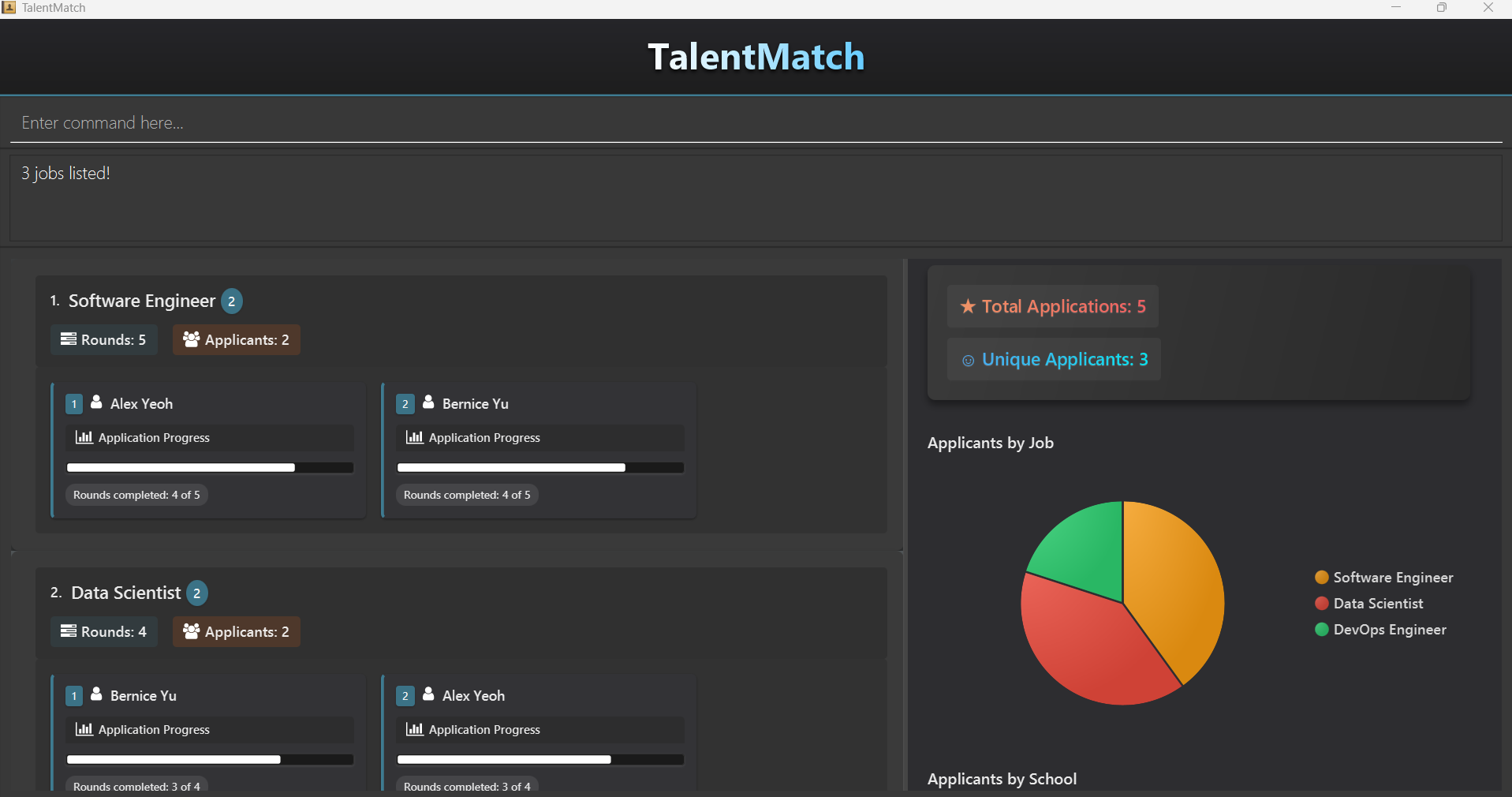
findjob data engineerfollowed byfindjob softwarereturns jobs which contains data or engineer, and software in its details.
Examples:
findjob Softwarereturns jobs that contain Software in their details.
Deleting a job: deljob
Deletes the specified job from TalentMatch.
Format: deljob INDEX
- Deletes the job at the specified
INDEX. - The index refers to the index number shown in the displayed job list.
- The index must be a natural number 1, 2, 3, …
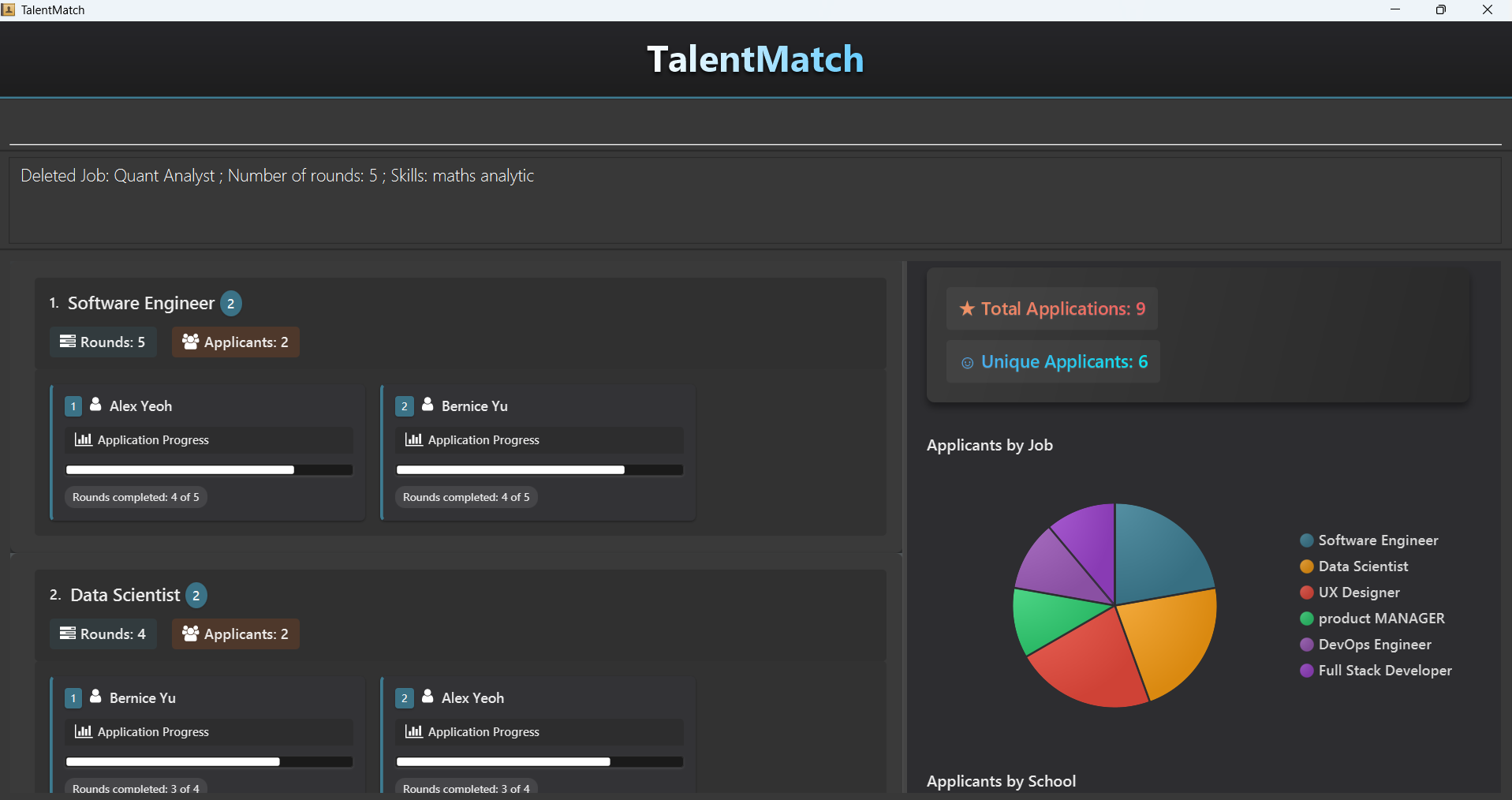
Expected output:
deljob 7 deletes the job at the 7th index.
Examples:
listjobfollowed bydeljob 2deletes the 2nd job in TalentMatch.findjob Software Engineeringfollowed bydeljob 1deletes the 1st job in the results of thefindjobcommand.
Person Commands
These commands support CRUD operations on Persons and are only available to you in Person View so that you are able to see real time updates on the GUI.
| Parameters | Definition | Constraints |
|---|---|---|
NAME | Name of the applicant | Only alphanumeric characters and spaces allowed, and should not be blank. |
PHONE_NUMBER | Phone number of the applicant | Should be a valid Singapore phone number (starts with 6, 8 or 9), and contain only 8 numbers. |
EMAIL | Email of the applicant | Emails should be of the format local-part@domain and adhere to the following constraints: 1. The local-part should only contain alphanumeric characters and these special characters, excluding the parentheses, (+_.-). The local-part may not start or end with any special characters. 2. This is followed by a '@' and then a domain name. The domain name is made up of domain labels separated by periods. The domain name must: - end with a domain label at least 2 characters long - have each domain label start and end with alphanumeric characters - have each domain label consist of alphanumeric characters, separated only by hyphens, if any. |
ADDRESS | Address of the applicant | Contains alphanumeric characters and special characters, and should not be blank. |
SCHOOL | School that the applicant is currently studying in | Only alphanumeric characters and spaces allowed, and should not be blank. |
DEGREE | Degree that the applicant is currently pursuing | Only alphanumeric characters and spaces allowed, and should not be blank. |
SKILL | Skills that the applicant possesses | Only alphanummeric charcters are allowed, with the exception of . and /. Skills should only be one word with no spaces. |
INDEX | Index of the person in the displayed person list in Person View | Must be a natural number and should be an index displayed in Person View. |
Adding a person: add
Adds a person to TalentMatch.
Format: add n/NAME s/SCHOOL d/DEGREE p/PHONE_NUMBER e/EMAIL a/ADDRESS [k/SKILL]…
Tip: A person can have any number of skills (including 0)
Expected output:
add n/John Doe s/NUS d/Computer Science p/98765432 e/johnd@example.com a/John street, block 123, #01-01 adds a person with the specified details.
Examples:
add n/John Doe s/NUS d/Computer Science p/98765432 e/johnd@example.com a/John street, block 123, #01-01adds a person with the specified details without skills.add n/Betsy Crowe s/NTU d/Civil Engineering k/Communication e/betsycrowe@example.com a/Newgate Prison p/97542384 k/Pythonadds a person with the specified details with skills.
Editing a person: edit
Edits an existing person in TalentMatch.
Format: edit INDEX [n/NAME] [s/SCHOOL] [d/DEGREE] [p/PHONE] [e/EMAIL] [a/ADDRESS] [k/SKILL]…
- Edits the person at the specified
INDEX. The index refers to the index number shown in the displayed person list. - The index must be a natural number 1, 2, 3, …
- At least one of the optional fields must be provided.
- Existing values will be updated to the input values.
- When editing skills, the existing skills of the person will be removed i.e adding of skills is not cumulative.
- You can remove all the person's skills by typing
k/without specifying any skills after it.
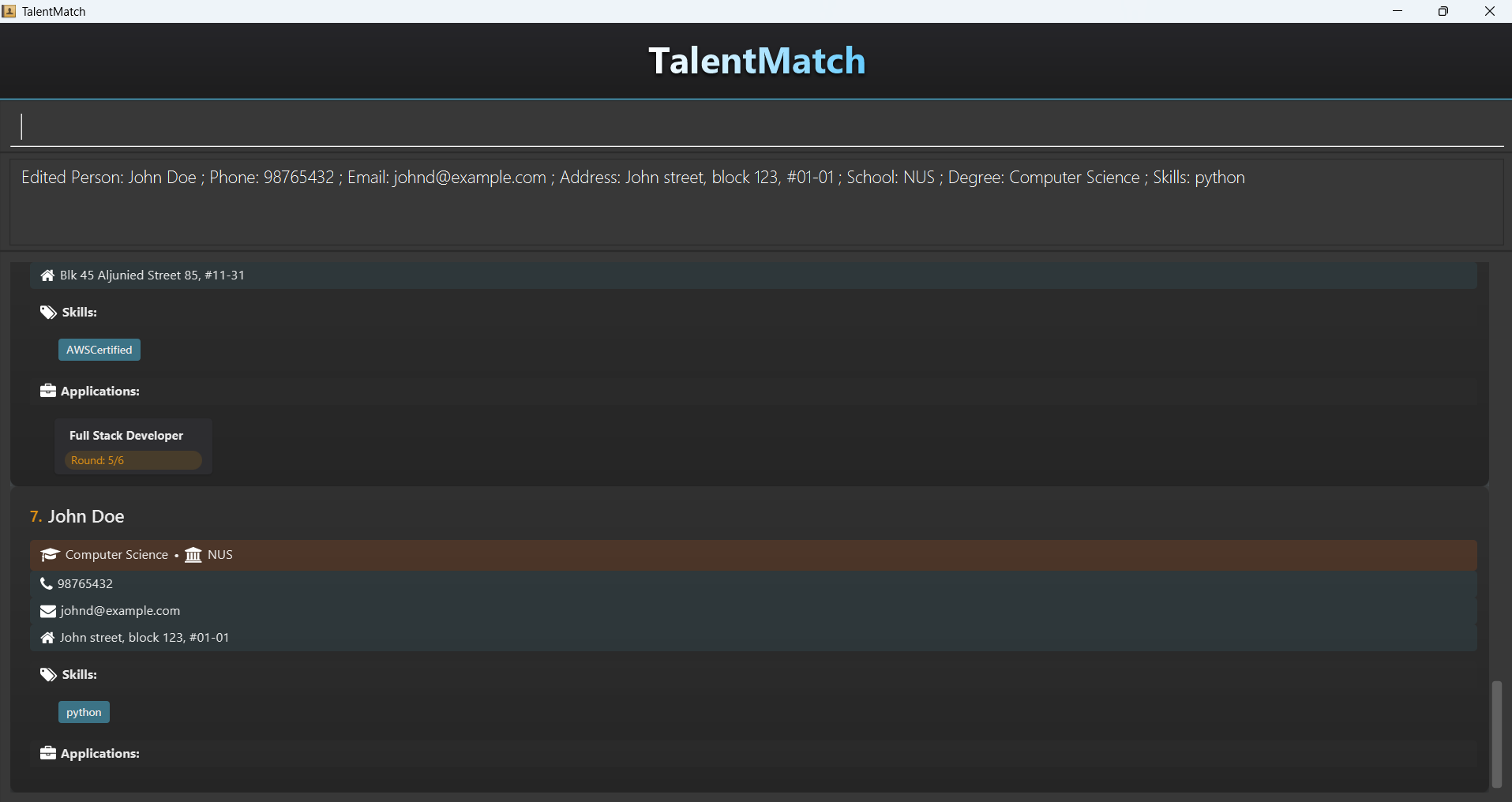
Expected output:
edit 7 k/python edits the person at the 7th index to have 1 skill.
Examples:
edit 1 p/91234567 e/johndoe@example.comEdits the phone number and email address of the 1st person to be91234567andjohndoe@example.comrespectively.edit 2 n/Betsy Crower k/Edits the name of the 2nd person to beBetsy Crowerand clears all existing skills.
Listing all persons: list
Shows a list of all persons in TalentMatch.
Format: list
Locating persons: find
Finds persons whose details contain any of the given keywords.
Format: find KEYWORD [MORE_KEYWORDS]…
- The search is case-insensitive. e.g.
hanswill matchHans - The order of the keywords does not matter. e.g.
Hans Bowill matchBo Hans - Only full words will be matched e.g.
Hanwill not matchHans - Persons matching at least one keyword will be returned (i.e.
ORsearch).
e.g.Hans Bowill returnHans Gruber,Bo Yang - Keywords are searched across multiple fields.
e.g.
find Alicewill return persons that contain Alice in any of the searchable fields. - Keywords used in a single
findjobcommand searches the displayed list using logical OR. e.g.find Hans Bowill returnHans Gruber,Bo Yang - Consecutive
findcommands continue the search based on the current displayed list. e.g.find Hans Bofollowed byfind Hanswill only returnHans Gruber - To reset the displayed list (i.e. when the displayed list is empty or the person you are searching for is no longer in the list), use
listto reset back to original list and continue searching again.
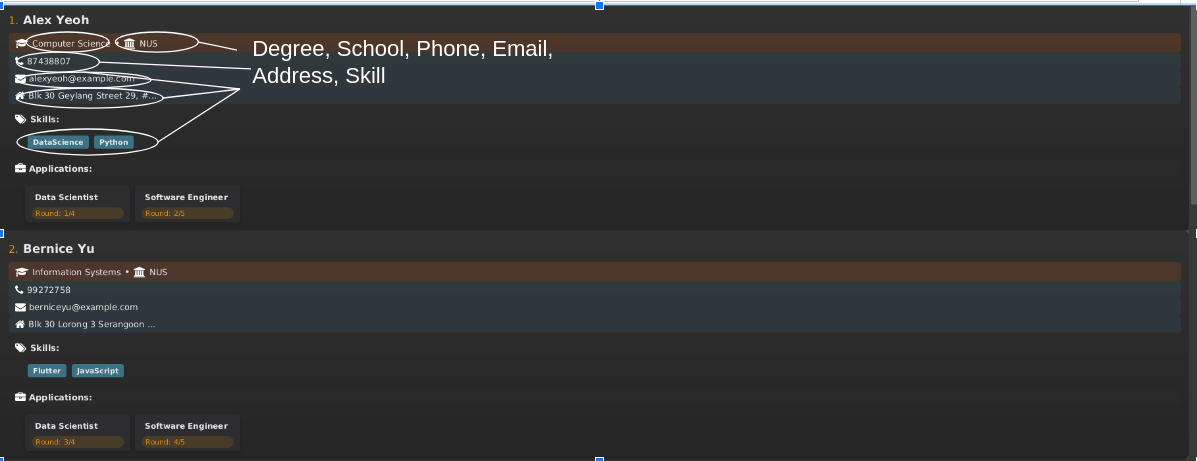
Searchable fields:
- NAME
- SCHOOL
- DEGREE
- PHONE
- ADDRESS
- SKILL
Expected output:
find alex irfanreturns persons who contain alex or irfan in their details
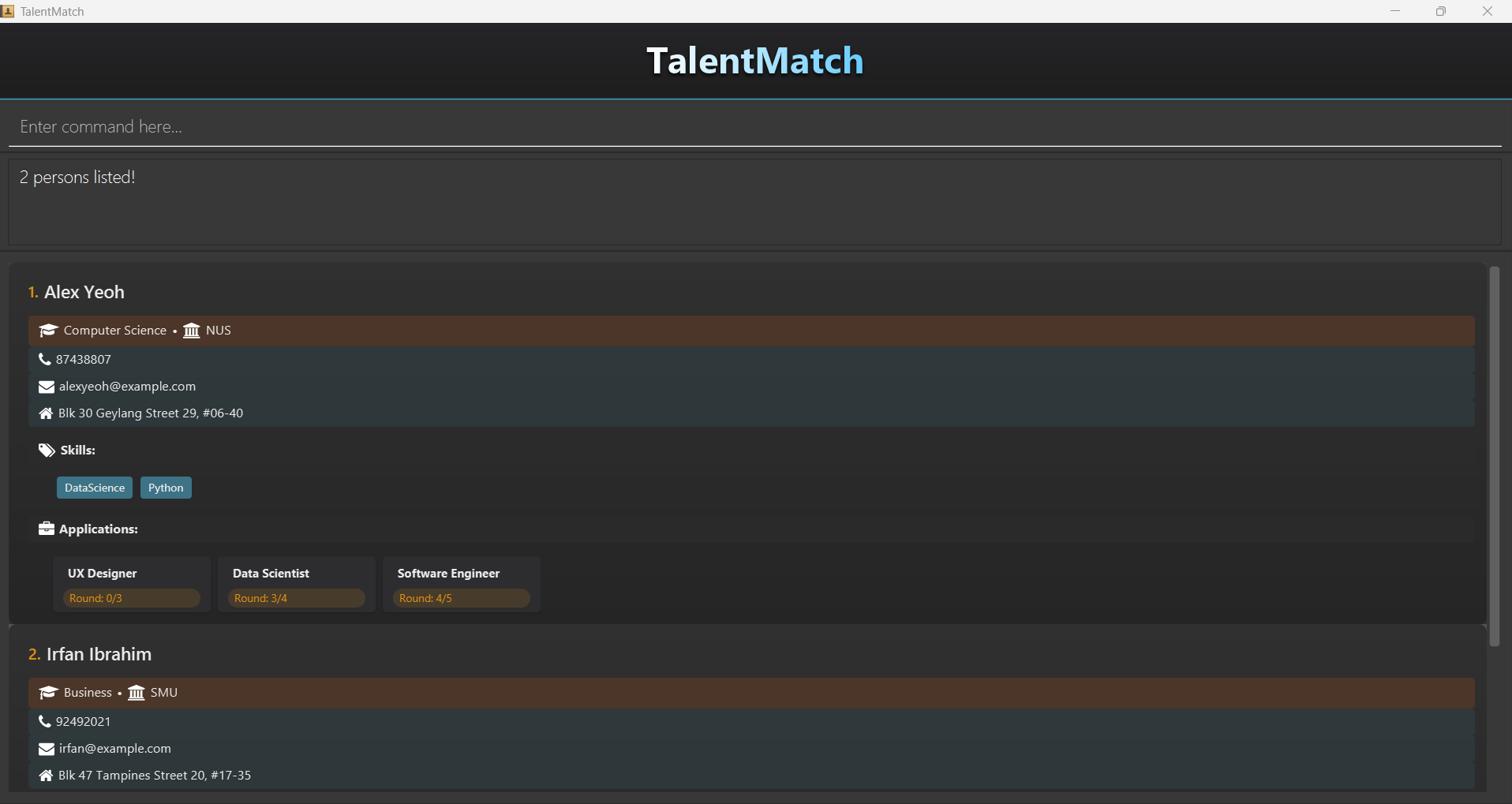
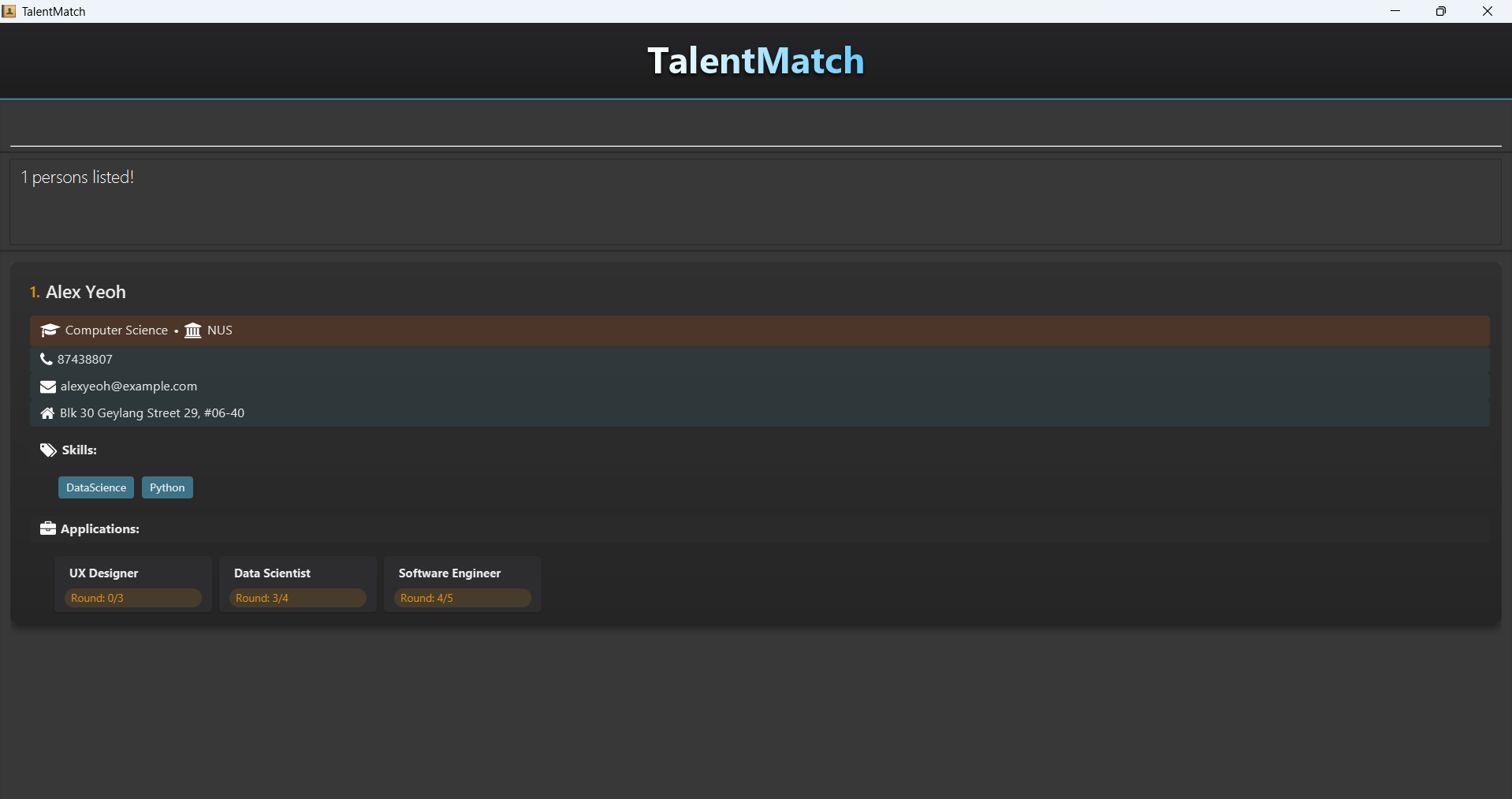
find alex irfanfollowed byfind yeohreturns persons who contain alex or irfan, and yeoh in their details.
Examples:
find JohnreturnsjohnandJohn Doefind alex davidreturnsAlex Yeoh,David Li
Deleting a person: del
Deletes the specified person from TalentMatch.
Format: del INDEX
- Deletes the person at the specified
INDEX. - The index refers to the index number shown in the displayed person list.
- The index must be a natural number 1, 2, 3, …
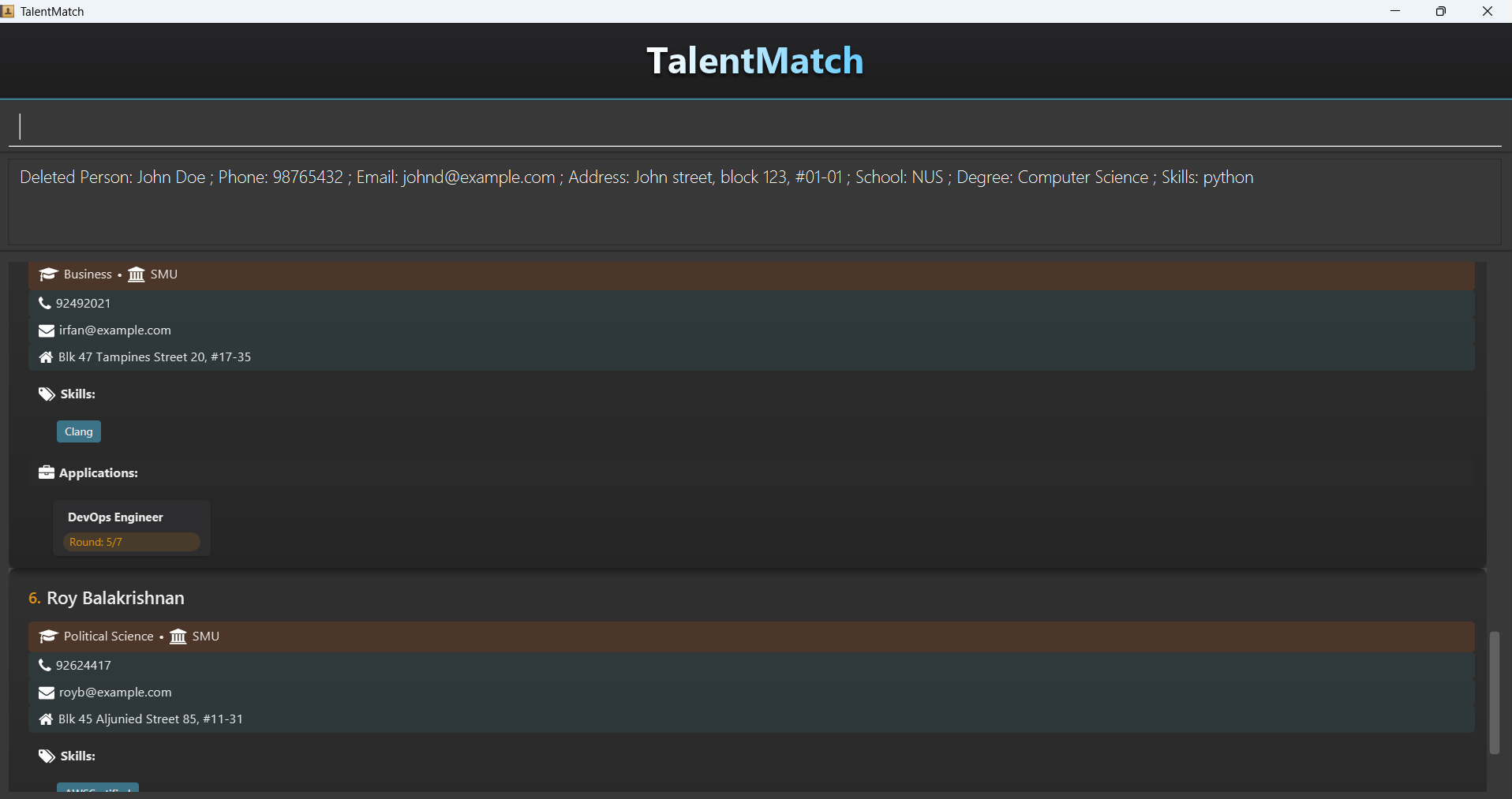
Expected output:
del 7 deletes the person at the 7th index.
Examples:
listfollowed bydel 2deletes the 2nd person in TalentMatch.find Betsyfollowed bydel 1deletes the 1st person in the results of thefindcommand.
Application Commands
These commands support CRUD operations on Applications and are only available to you in Job View so that you are able to see real time updates on the GUI.
| Parameters | Definition | Constraints |
|---|---|---|
PERSON_INDEX | Index of the person in the displayed person list in Person View | Must be a natural number and should be an index displayed in Person View. |
JOB_INDEX | Index of the job in the displayed job list in Job View | Must be a natural number and should be an index displayed in Job View. |
APPLICATION_STATUS | A numerical value indicating an applicant's progress through the interview process | Must be a positive integer >= 0 and should be less than or equal JOB_ROUNDS of that particular job. |
APPLICATION_INDEX | Index of the application in the displayed job list in Job View | Must be a natural number and should be an index displayed in Job View. |
- Status 0: The applicant has just applied and hasn't undergone any interviews yet.
- Status k (where k is between 1 and total rounds - 1): The applicant has successfully PASSED round k and is waiting for the next round.
- Status = Job Rounds: The applicant has passed all interview rounds and has been offered the position.
Here is a brief label of the various parameters:
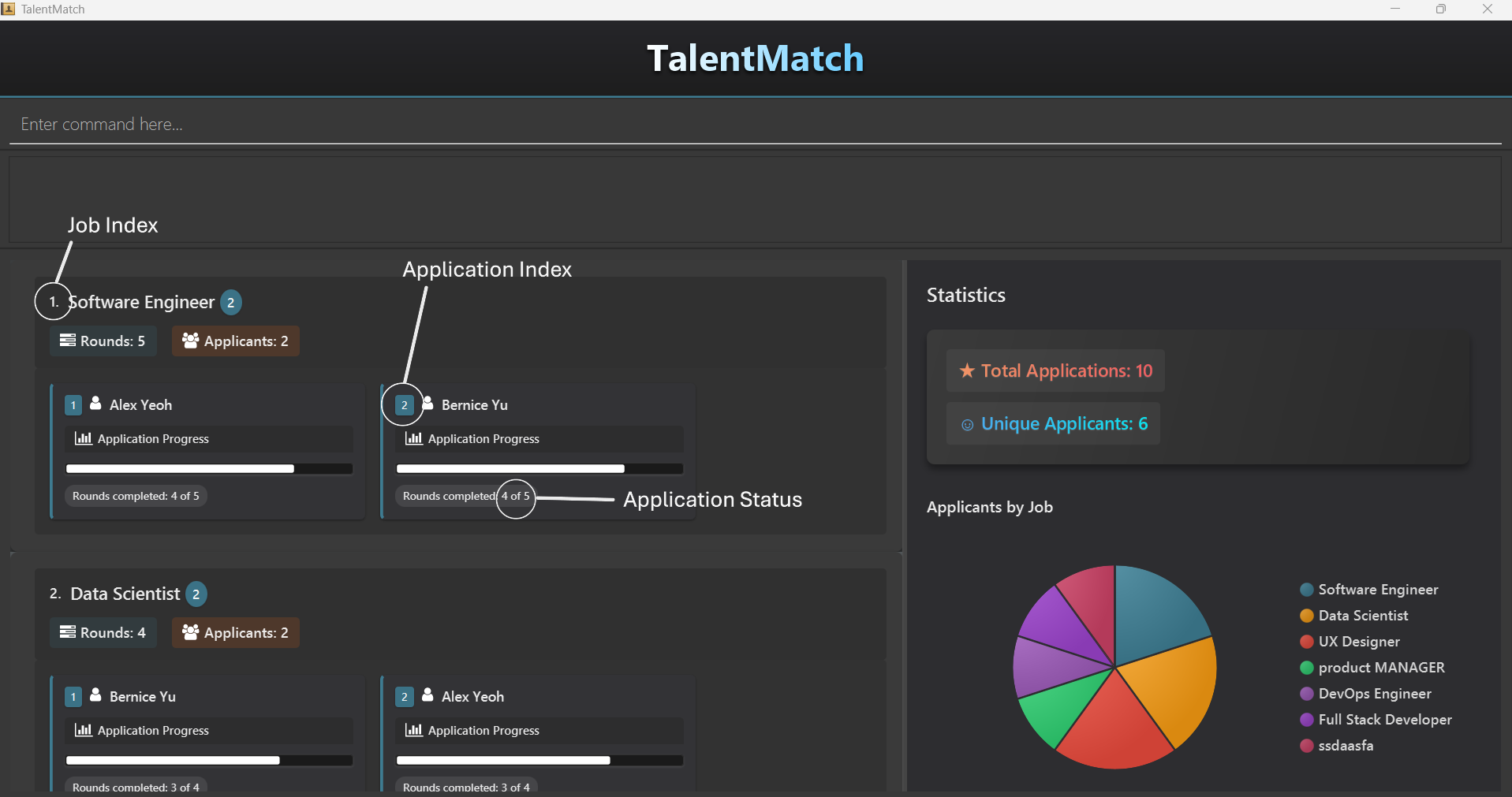
Adding an application: addapp
Adds an application to TalentMatch
Format: addapp ip/PERSON_INDEX ij/JOB_INDEX
- All applications start from the 0th round each time (start at 0 of JOB_ROUNDS when added).
- The
PERSON_INDEXcan be obtained by switching to Person View in TalentMatch. - The
JOB_INDEXcan be obtained by switching to Job View in TalentMatch. addappis the only application command that is available to you in both Person and Job view.
Warnings:
- Target person and job should already exist in TalentMatch prior to creation of an application for the target person and job.
- Person and job indices must be valid positive integers existing in the respective views.
- Important: Person and job indices depend on the current state of the displayed list in Person and Job View.
- No existing applications must be present.
TalentMatch flags duplicate applications for the same applicant and job out with this exception message:
This application already exists in the address book Try using delapp instead!
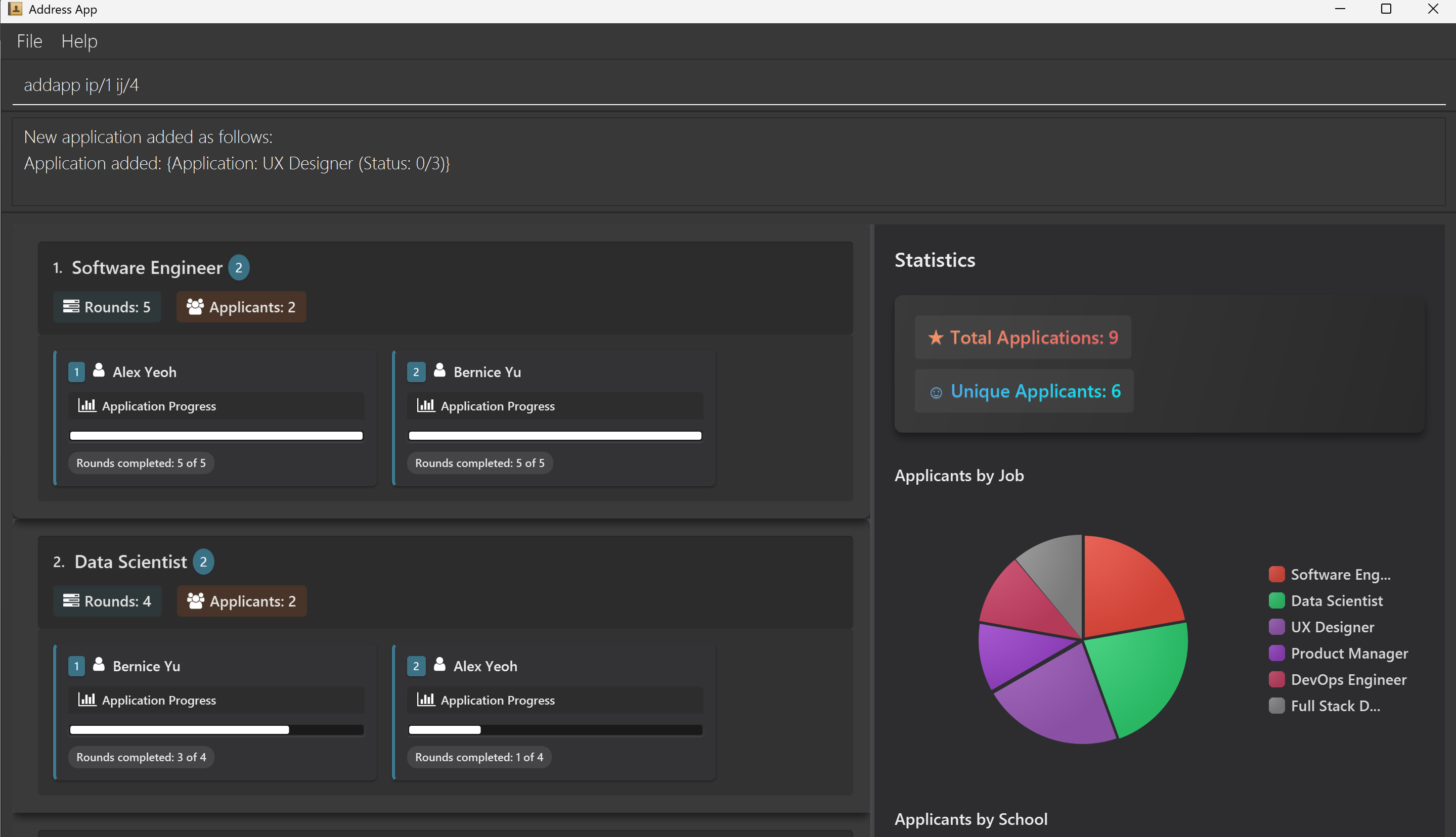
Expected output:
addapp ip/1 ij/4 adds an application which has the person at index 1 as the applicant and the job at index 4 as the job that he/she is applying for.
Examples:
addapp ip/3 ij/6adds an application for the 3rd person to the 6th job in the current displayed person and job list respectively.
Locating application: findapp
Finds application by JOB_INDEX and APPLICATION_STATUS in Job View.
Format: findapp as/APPLICATION_STATUS [ij/JOB_INDEX]
Tip:
- Both the job index and application status can be retrieved from the job view alone.
- Using
APPLICATION_STATUSon its own returns all applications with the specifiedAPPLICATION_STATUS. - Using
APPLICATION_STATUSandJOB_INDEXreturns all applications under the specified job atJOB_INDEXwith the specifiedAPPLICATION_STATUS. findappworks on the current displayed list of jobs (i.e. if there are multiple jobs with applications with anAPPLICATION_STATUSof 3 in TalentMatch, but only 1 job is currently displayed on the job list,findapp as/3returns only that 1 job).- Use
listjobto clear any existing filters to reset the search space to the entire job list.
Warnings:
JOB_INDEXandAPPLICATION_STATUSmust be valid positive integers (exception ofAPPLICATION_STATUShaving 0) existing in the respective views.- The index must be a natural number 1, 2, 3, …
- The desired application must already exist in TalentMatch. TalentMatch cannot find a non-existent application!
findjobcan be used alongsidefindapp, however do note that all searches will search the current displayed list.- i.e. Suppose job A has 3 applications (2 of which have
APPLICATION_STATUSof 2),findapp as/2returns all applications withAPPLICATION_STATUSof 2, usingfindjob Aafter will return job A with only 2 applications shown (despite there existing 3 applications).
- i.e. Suppose job A has 3 applications (2 of which have
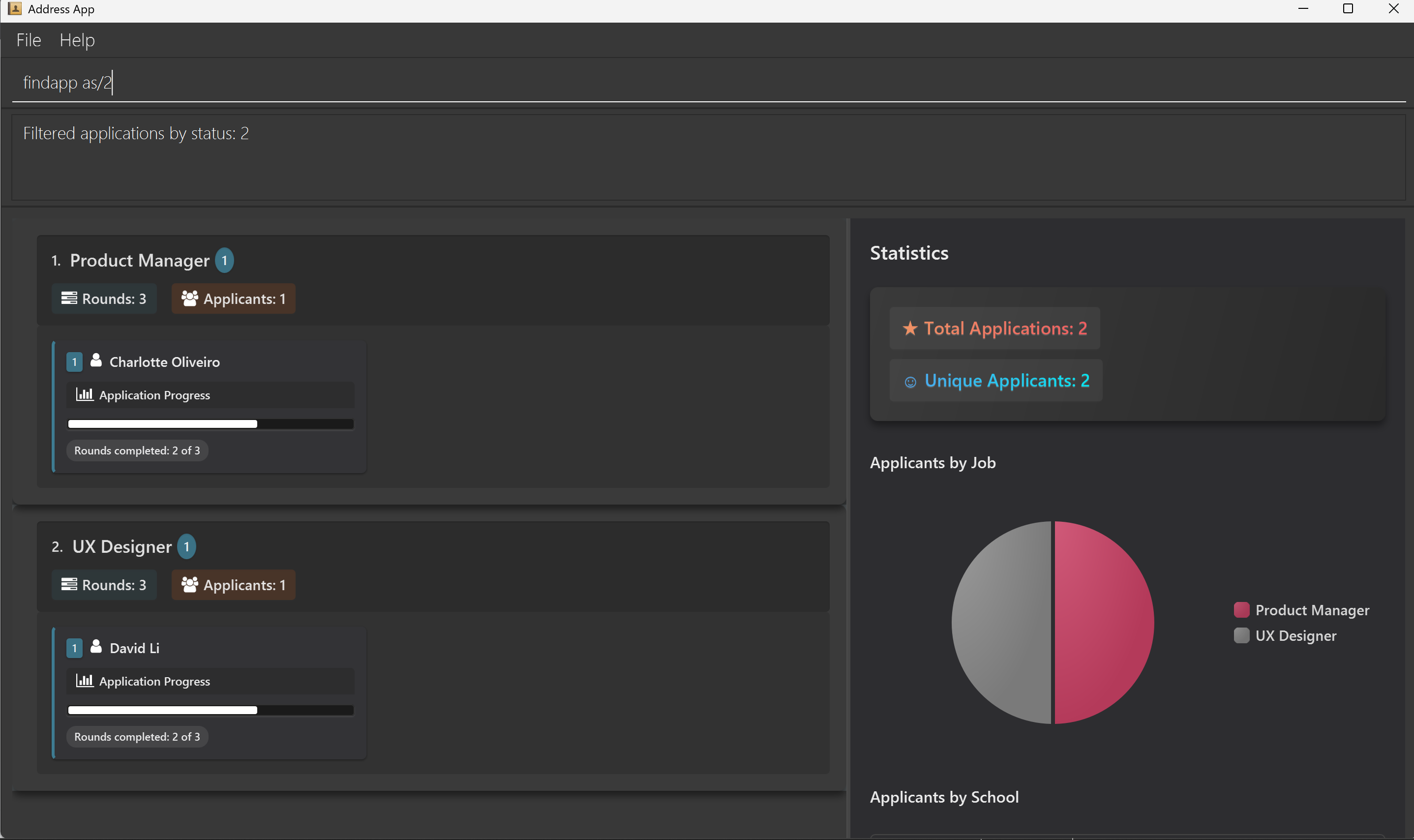
Expected output:
findapp as/2 returns all applications in TalentMatch that currently have APPLICATION_STATUS of 2.
Example:
findapp as/3 ij/2 returns all applications with APPLICATION_STATUS of 3 for the 2nd job in the displayed job list.
Deleting an application: delapp
Deletes the specified application from TalentMatch.
Format: delapp ij/JOB_INDEX ia/APPLICATION_INDEX
Tip: Both the job and application indices can be obtained from the job view alone.
Warnings:
JOB_INDEXandAPPLICATION_INDEXmust be valid positive integers existing in Job View.- The index must be a natural number 1, 2, 3, …
- A unique existing application must be present.
TalentMatch flags deleting non-existent applications with this exception message:
This application does not exist in the address book. Try using addapp to add an application first!
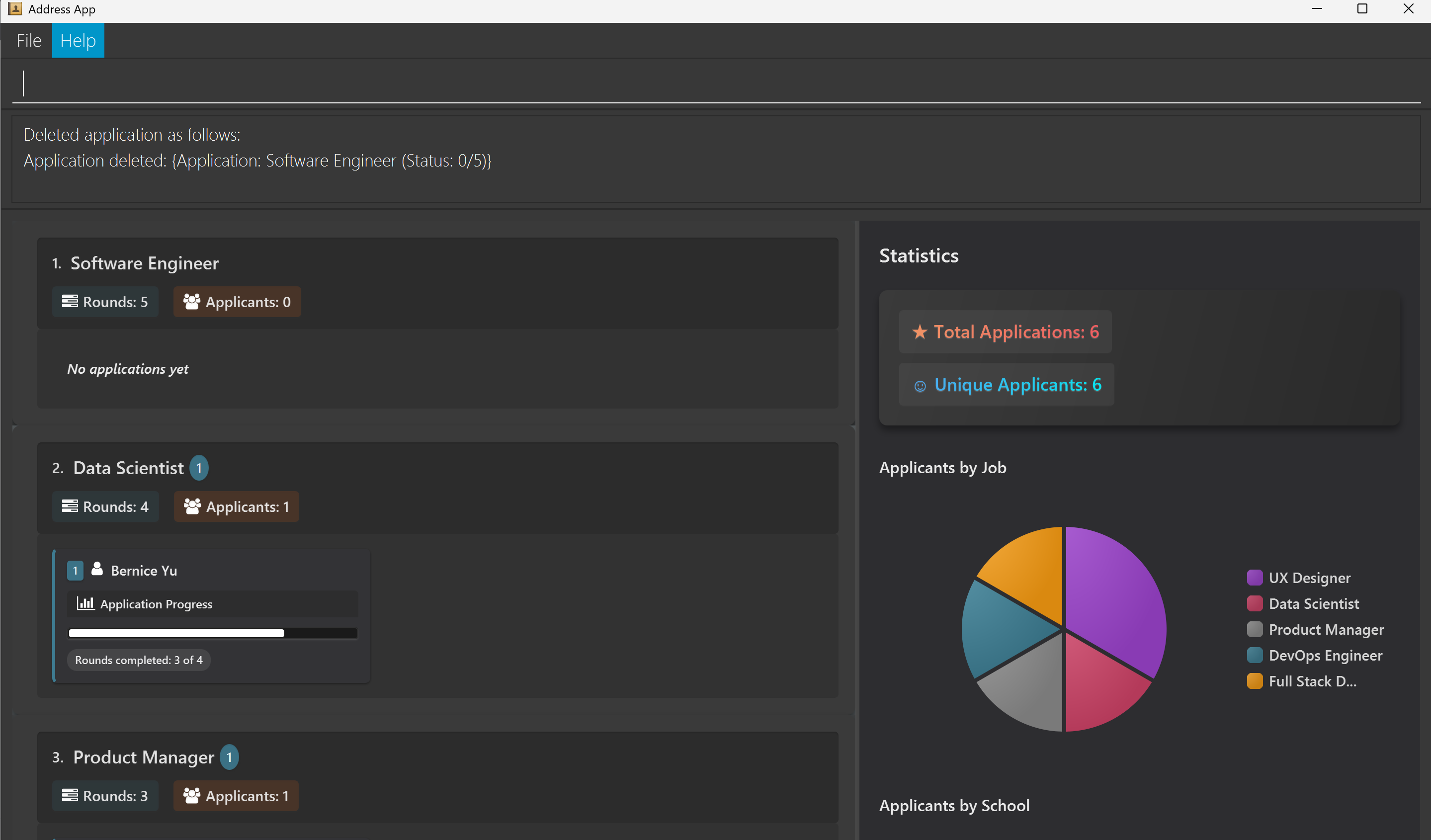
Expected output:
delapp ij/1 ia/1 deletes the 1st application for the 1st job.
Example:
delapp ij/2 ia/3 deletes the 3rd application for the 2nd job.
Advancing applications: advapp
Advances an application to the next round of interview.
Format: advapp ij/JOB_INDEX ia/APPLICATION_INDEX
- All applications are advanced by exactly 1 round each time.
- You should exercise discretion in advancing an application as it signifies that the applicant has not only gone for the round, but also passed it! Therefore, an applicant who has reached the final round of an application (i.e. round 5 of 5) will be deemed to have received a job offer. Congratulations!
- You should exercise discretion in advancing an application of any applicant who has reached the final round of another application, as this would otherwise imply the applicant has more than 1 offers for this company!
Warnings:
JOB_INDEXandAPPLICATION_INDEXmust be valid indices existing in Job View.- The index must be a natural number 1, 2, 3, …
- A unique existing application must be present.
TalentMatch flags advancing non-existent applications out with this exception message:
This application does not exist in the address book. Try using addapp to add an application first!
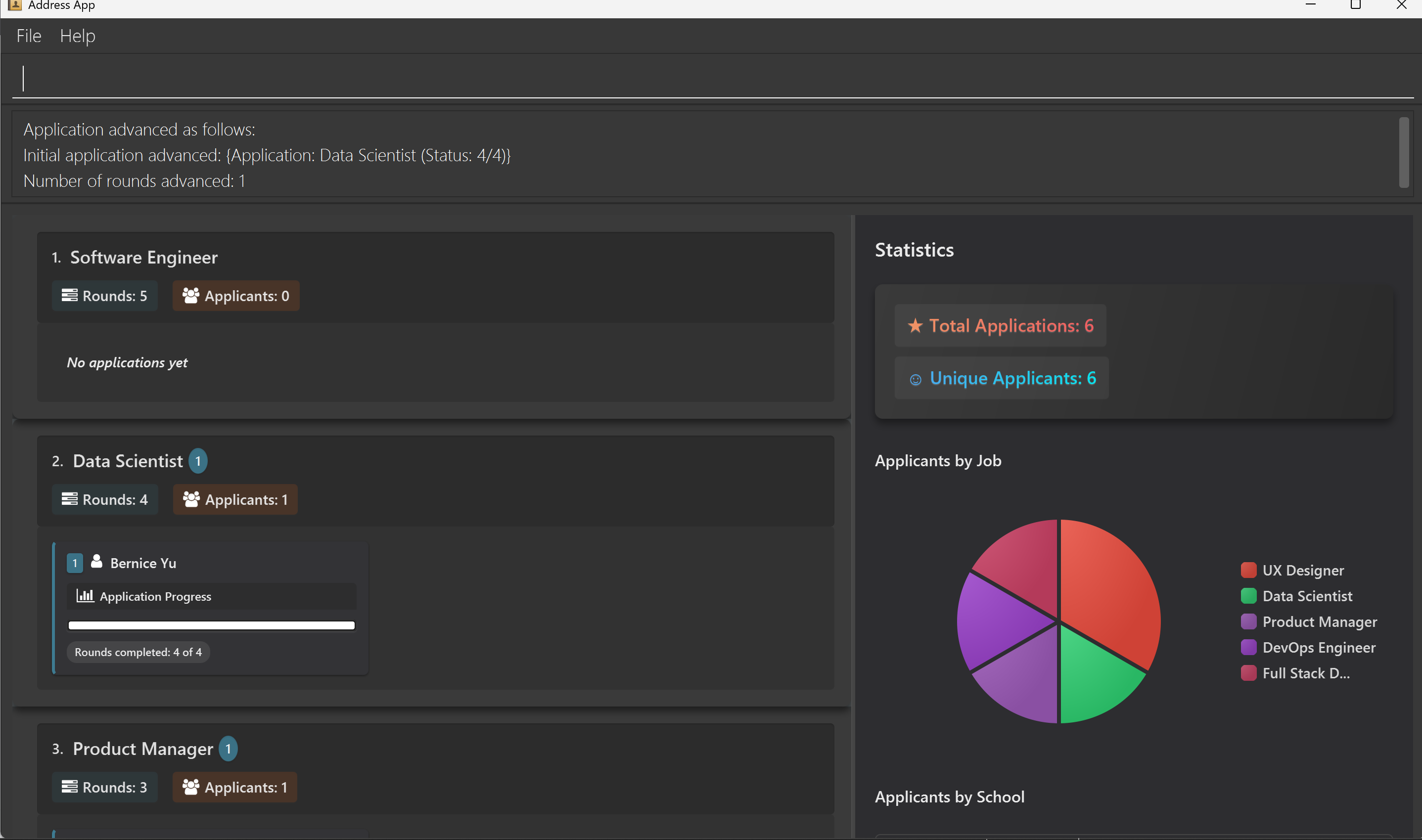
Expected output:
advapp ij/2 ia/1 advances the 1st application for the 2nd job by one round.
Example:
advapp ij/1 ia/2advances the 2nd application for the 1st job by one round (if it exists).
Viewing job details: viewjob
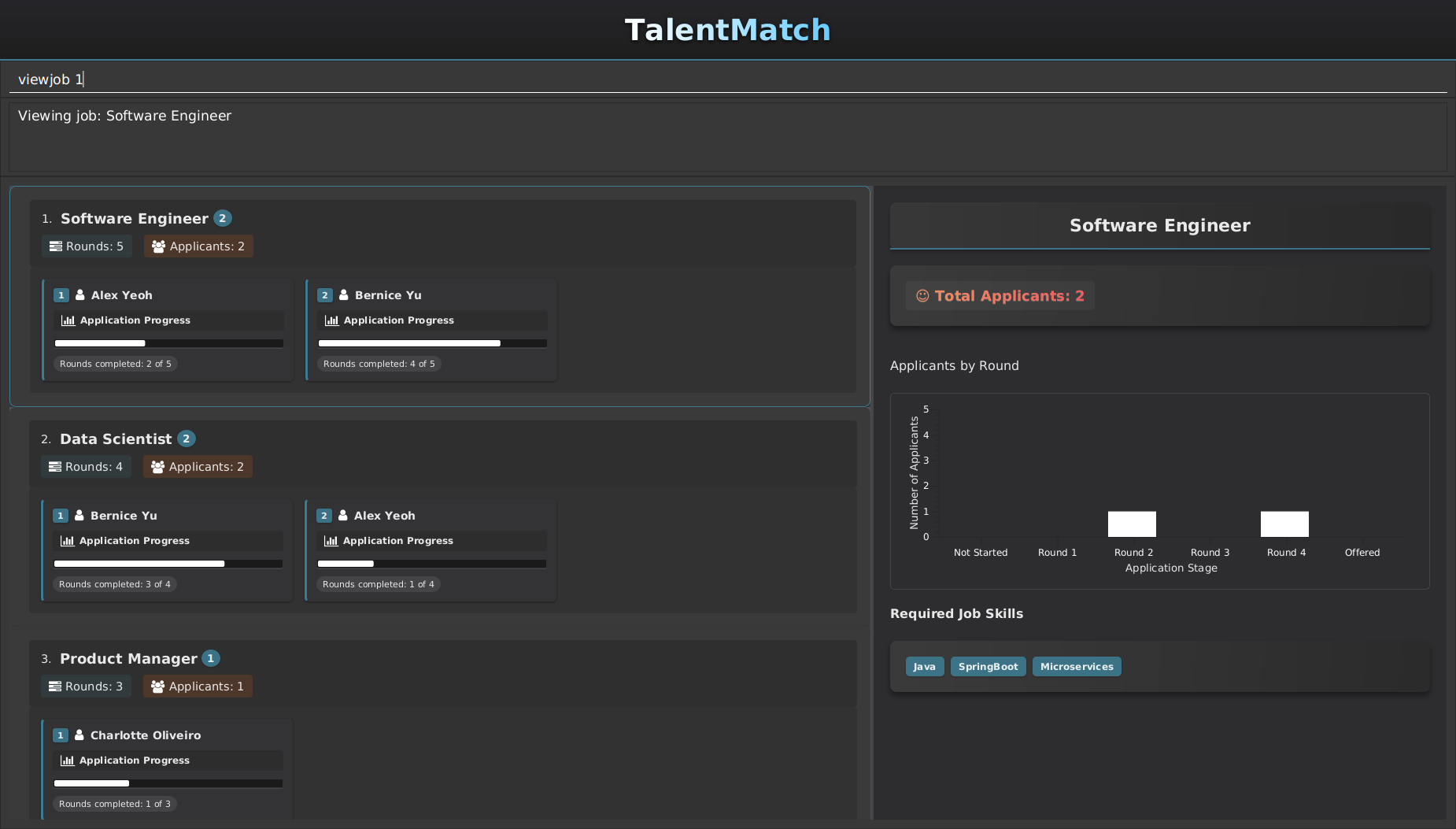
Displays a sidebar that shows the job title and the number of applicants for that job. It also shows the distribution of applicants across different interview rounds in a bar chart, and the skills required for the job.
Format: viewjob INDEX
- Shows detailed information of the job at the specified
INDEX. - The index refers to the index number shown in the displayed job list.
- The index must be a natural number 1, 2, 3, …
Expected output:
viewjob 1displays information about the 1st job in the sidebar.
Examples:
listjobfollowed byviewjob 2displays detailed information of the 2nd job in TalentMatch.viewjob 1shows detailed information about the first job in the current list.viewjob 10will return a INVALID_INDEX_MESSAGE if there is no job at index 10.viewjob 0will return a INVALID_COMMAND_MESSAGE as the index must be a natural number.
Viewing person details from job application: viewperson
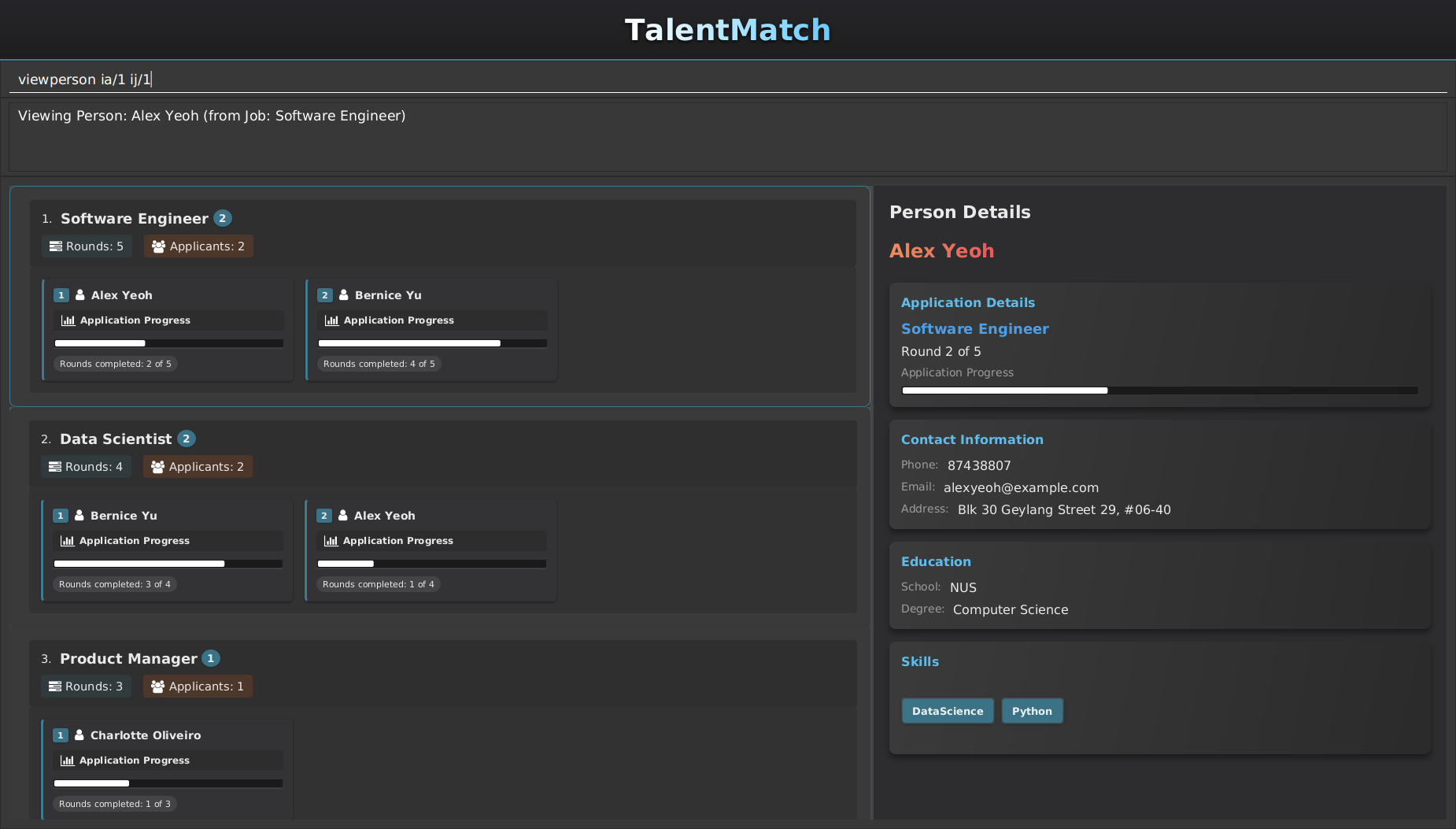
Shows a sidebar that shows the applicant's name, school, degree, phone number, email, address, and skills. It also shows the application status of the applicant for the job through a progress bar.
Format: viewperson ij/JOB_INDEX ia/APPLICATION_INDEX
- Shows detailed information of the person associated with the application at the specified
APPLICATION_INDEXfor the job at the specifiedJOB_INDEX. - Both indices refer to the index numbers shown in the respective displayed lists.
- Both indices must be natural numbers 1, 2, 3, …
Expected Output:
viewperson ia/1 ij/1displays information about the 1st applicant of the 1st job in the sidebar.
Examples:
viewperson ij/1 ia/1in job view will generate a sidebar with detailed information of the applicant associated with the 1st application for the 1st job (if it exists).viewjob 1followed byviewperson ij/1 ia/2displays detailed information of the applicant associated with the 2nd application for the 1st job.viewperson ij/1 ia/2will return a NOT_FOUND_MESSAGE if there are no applications at index 2 for the job at index 1.viewperson ij/1 ia/0will return a INVALID_COMMAND_MESSAGE as the application index must be a natural number.
Saving the data
TalentMatch data are saved in the hard disk automatically after any command that changes the data. There is no need to save manually.
Editing the data file
TalentMatch stores data in two separate JSON files:
[JAR file location]/data/addressbook.json- Contains all person and job data[JAR file location]/data/applicationbook.json- Contains all application data linking persons to jobs
Advanced users can update data directly by editing these files, but caution is advised.
Do note that all case-insensitive fields are stored in lowercase in these files and casing is done automatically by TalentMatch.
Caution: If your changes to the data files make their format invalid, TalentMatch will handle it as follows:
If you correctly edit the files and maintain valid format:
- TalentMatch will load your edited data on next startup
- All relationships between persons, jobs, and applications will be preserved
- Your changes will be immediately reflected in the UI
If the address book file is invalid or missing:
- TalentMatch will load sample data for both persons/jobs and applications
- A warning will be logged, but the application will still start
If only the applications file is invalid or missing:
- TalentMatch will keep the existing persons/jobs data
- It will create a new, empty applications manager
- This means all links between persons and jobs will be lost
If both files are valid but contain inconsistencies:
- Applications referring to non-existent persons or jobs may cause unexpected behavior
It is strongly recommended to:
- Back up both data files before editing them
- Keep the file format and data consistent across both files
- Restart the application after making direct edits to verify your changes
FAQ
Q: How do I transfer my data to another Computer?
A: Install the app in the other computer and overwrite the empty data file it creates with the file that contains the data of your previous AddressBook home folder.
Q: Why are the commands limited to specific views?
A: We limit commands to their specific views to ensure you are able to see real time updates in the GUI. This is in consideration of the case you type the wrong command and accidentally
change data in the other view unknowingly.
Q: Why are the find commands so restrictive?
A: TalentMatch is built with the assumption that experienced users will be unlikely to make typing mistakes when searching for a certain job/person, hence having a find function that continuously
reduces the search space improves your experience by being able to narrow down your displayed lists for easier addition of applications. In the event of typing a wrong keyword, you can use list/listjob in the
appropriate view to reset your current search and try searching again.
Q: Why are skills limited to 1 word?
A: TalentMatch follows typical resume formats where skills are listed as single words. In the event of skills that take up multiple words, you can compromise by
concatenating them into a single word.
Known issues
UI Issues
- Multiple Window Usages: When using multiple screens, if you move the application to a secondary screen, and later switch to using only the primary screen, the GUI will open off-screen. The remedy is to delete the
preferences.jsonfile created by the application before running the application again. - Minimizing the Help Window: If you minimize the Help Window and then run the
helpcommand again, the original Help Window will remain minimized, and no new Help Window will appear. The remedy is to manually restore the minimized Help Window. - Text Truncation in Display: Long text entries may be truncated with "..." when the application window isn't wide enough. You may not be able to see the complete information for some fields.
- Viewport Issues: Parts of the application may be cut off at smaller window sizes, including the default size at first startup. We have included a minimum viewport size for most devices, however in the case where your device is unable to support this viewport, then you may run into unexpected UI issues as mentioned before.
- Oversized Messages: Some success and error messages may be too long to read easily in the current application.
- Inconsistent Casing: TalentMatch automatically capitalizes the case-insensitive fields, which could result in weird capitalization in some cases.
Data Storage Issues
- Storage File Synchronization: The application generates two storage files: applicationsmanager.json and addressbook.json. Both files contain information related to persons and jobs. If you make changes to persons or jobs in one file, you MUST replicate these changes in the other file. Failure to synchronize these files will result in data mismatches when the application loads, leading to undefined application behavior.
- Command Syntax Sensitivity: Any non-adherence to the case sensitivity and input validation rules given in the command descriptions may cause unexpected errors. You should read through and follow these case sensitivity and input validation rules carefully.
- Multiple Instance Conflicts: Running multiple instances of the application simultaneously can corrupt your data files. You should only run one instance of TalentMatch at a time. Close any existing instance before opening a new one.
- Skill Storage Limitation: Adding skills that are more than 1 word long will result in an error. You can concatenate the skill into a single word before adding them as a compromise.
Command summary
| Action | Format, Examples |
|---|---|
| Add | add n/NAME s/SCHOOL d/DEGREE p/PHONE_NUMBER e/EMAIL a/ADDRESS [k/SKILL]… e.g., add n/James Ho s/NUS d/Physics p/83920347 e/jamesho@example.com a/123, Clementi Rd, 1234665 k/python k/java |
| AddJob | addjob jt/JOB_TITLE jr/INTERVIEW_ROUNDS [k/SKILL]… e.g., addjob jt/Software Engineering jr/3 k/Python |
| AddApp | addapp ip/PERSON_INDEX ij/JOB_INDEX e.g., addapp ip/1 ij/1 |
| AdvApp | advapp ij/JOB_INDEX ia/APPLICATION_INDEX e.g., advapp ij/1 ia/1 |
| Clear | clear |
| Delete | del INDEXe.g., del 3 |
| DeleteJob | deljob INDEX e.g., deljob 3 |
| DeleteApp | delapp ij/JOB_INDEX ia/APPLICATION_INDEX e.g., delapp ij/1 ia/1 |
| Edit | edit INDEX [n/NAME] [s/SCHOOL] [d/DEGREE] [p/PHONE_NUMBER] [e/EMAIL] [a/ADDRESS] [k/SKILL]…e.g., edit 2 n/James Lee e/jameslee@example.com |
| EditJob | editjob INDEX [jt/JOB_TITLE] [jr/INTERVIEW_ROUNDS] [k/SKILL]… e.g., editjob 7 jt/Software Engineering jr/3 |
| Find | find KEYWORD [MORE_KEYWORDS]…e.g., find James Jake |
| FindJob | findjob KEYWORD [MORE_KEYWORDS]…e.g., findjob Software Engineering |
| FindApp | findapp as/APPLICATION_STATUS [ij/JOB_INDEX] e.g., findapp as/2 ij/1 |
| Help | help |
| List | list |
| ListJobs | listjob |
| Switch | switch |
| ViewJob | viewjob INDEX e.g., viewjob 3 |
| ViewPerson | viewperson ij/JOB_INDEX ia/APPLICATION_INDEX e.g., viewperson ij/1 ia/2 |